The Raven
The RavenThe Raven is the poem’s ebony visitor, a stately and ominous bird whose arrival transforms a private chamber into a scene of psychological and metaphysical judgment. It enters through the shutter, perches above the chamber door on a bust of Pallas, and repeatedly answers the narrator with “Nevermore.” Although its motives and origins remain unresolved, its fixed voice acquires increasingly devastating significance as the narrator directs his questions toward lost friends, forgetfulness, divine consolation, and reunion with Lenore.
Identity and Introduction
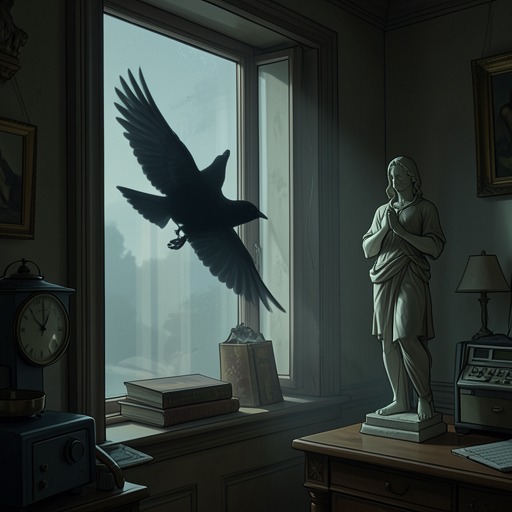
The Raven first appears when the narrator opens the shutter after hearing tapping that he has attributed to the wind. The bird steps into the chamber with “many a flirt and flutter,” but its entrance is not timid or submissive. It makes no obeisance, pauses for no formal exchange, and assumes its position with “mien of lord or lady.” Its destination is precise: it perches on a bust of Pallas directly above the chamber door, where the association with wisdom contrasts sharply with its black, grave, and uncanny presence.
The narrator gives the bird several competing identities. It is an “ancient Raven wandering from the Nightly shore,” a fowl capable of discourse, a “thing of evil,” a “prophet,” and perhaps either a bird or a devil. The narrator also wonders whether it was sent by a Tempter or cast ashore by a tempest. None of these possibilities is confirmed. The Raven therefore remains suspended between ordinary animal life and supernatural agency: it is visibly a bird, yet its humanly intelligible answer makes it seem to possess intention, authority, and access to knowledge beyond the chamber.
Its first answer is “Nevermore,” spoken after the narrator asks for its lordly name on the Night’s Plutonian shore. The answer initially appears to have little meaning or relevance, and the narrator treats it as a learned phrase or a piece of verbal stock acquired from an unhappy former master. This explanation briefly restores the bird to the category of trained animal. Yet the very clarity and timing of its speech keep that reduction from holding. The Raven’s apparent lack of understanding becomes inseparable from the narrator’s increasingly desperate effort to understand it.
Conduct and Repeated Speech
The Raven’s power depends less on action than on stillness. After perching, it remains lonely on the placid bust, speaks only the one word, and pours its apparent soul into that word. It utters nothing further and does not flutter a feather. This disciplined immobility gives the answer a force that a more active creature might not possess. The bird does not explain, argue, comfort, or threaten in ordinary language; it allows the narrator’s own questions to enlarge the meaning of its refrain.
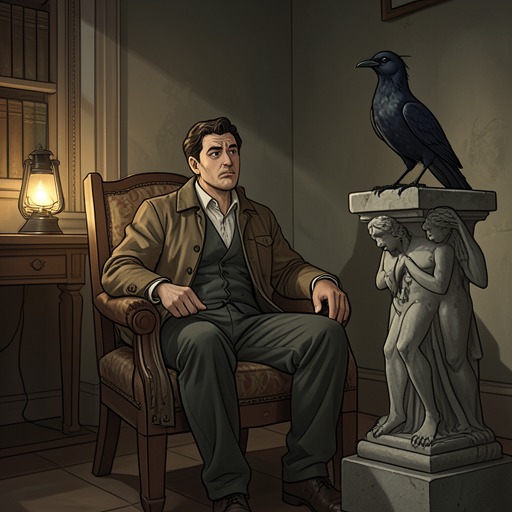
The repetition develops in stages. When the narrator predicts that other friends have flown before and that the bird will leave him on the morrow, the Raven again says “Nevermore.” The answer now seems to confirm the narrator’s expectation of abandonment. Later, after the narrator imagines that the bird’s former master taught it the melancholy burden of “Never—nevermore,” the refrain becomes attached to Hope itself. The narrator then wheels a cushioned seat before the bird, the bust, and the door, and begins linking fancy unto fancy, trying to determine what the grim, ungainly, ghastly, gaunt, and ominous bird means by croaking the word.
This arrangement turns the Raven into a mechanism for compulsive interpretation. Its fiery eyes burn into the narrator’s bosom’s core, but the bird does not need to move in order to dominate the scene. Each repetition preserves the same sound while changing its object. “Nevermore” moves from a name, to a prediction of departure, to a dirge for Hope, and finally to an answer concerning the possibility of relief and reunion. The Raven’s silence between utterances is as important as the utterance itself: every pause leaves room for the narrator to supply a more painful question.
Relationship with the Narrator
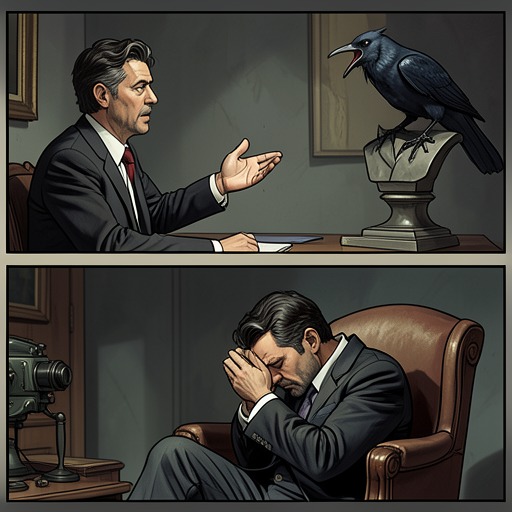
The Raven’s relationship with the narrator is defined by asymmetry. The narrator speaks at length, addresses the visitor as “Sir,” “Madam,” “Prophet,” and “thing of evil,” and repeatedly demands information. The Raven does not acknowledge these changing forms of address. It neither bows nor retreats, and its one-word response refuses the conversational reciprocity that the narrator seeks. The narrator’s authority over his own chamber and language is thus challenged by a creature that occupies the highest visible point above the door while offering no account of itself.
At first, the Raven’s grave decorum beguiles the narrator’s sad fancy into smiling. The strange visitor briefly interrupts sorrow by giving it an object that can be watched, named, and questioned. The narrator’s attempts to manage his distress proceed through successive strategies: he reads in search of surcease from sorrow, repeats reassuring explanations about the knocking, opens the shutter to verify the source, and then tries to classify the bird as a trained creature with a limited vocabulary. The Raven defeats each strategy without visibly exerting force. Its fixed answer converts the narrator’s efforts at emotional regulation into further occasions for grief.
The bird also becomes the external form of a conflict that the narrator cannot resolve internally. He asks whether relief from memories of Lenore may come through nepenthe, whether there is balm in Gilead, and whether he will clasp Lenore in the distant Aidenn. These questions move from temporary forgetfulness, to healing, to an ultimate reunion. The Raven answers “Nevermore” each time. Whether the bird possesses supernatural knowledge or merely repeats a learned sound is left open, but the narrator receives the refrain as a sequence of final judgments. The uncertainty of the Raven’s agency does not lessen its effect; it makes the narrator responsible for turning an ambiguous sound into an absolute sentence.
Conflict, Refusal, and Ending
The narrator’s questioning eventually becomes accusation. He calls the Raven a prophet and a thing of evil, asks whether it is a bird or devil, and demands truth by invoking Heaven and God. The bird still provides no explanation. Its refusal is not expressed through flight or overt aggression but through persistence: it remains exactly where it has chosen to sit and continues to answer in the same way.
The narrator finally attempts to end the encounter by commanding the bird to return to the tempest and the Night’s Plutonian shore. He orders it to leave no black plume as a token of the lie its soul has spoken, to leave his loneliness unbroken, and to quit the bust above the door. He also commands it to take its beak from his heart and its form from the door. The Raven responds once more with “Nevermore.” The answer turns the narrator’s order into a failed act of banishment and makes the bird’s refusal to leave the decisive outcome of their conflict.
The ending fixes the Raven in an almost immovable tableau. It is still sitting on the pallid bust of Pallas above the chamber door, while the lamp-light throws its shadow across the floor. Its eyes have the seeming of a demon that is dreaming. The narrator’s soul lies within that shadow and, in the poem’s final assertion, shall be lifted “nevermore.” The Raven’s final significance therefore exceeds its physical presence: it becomes the enduring shape of a grief from which the narrator cannot escape. Its body remains in the room, its shadow remains on the floor, and its refrain becomes inseparable from the narrator’s own fate.
Narrative and Thematic Significance
As an animal character, The Raven occupies a deliberately unstable position. The narrator repeatedly names it as bird, beast, fowl, and ebony bird, but also grants it speech, prophetic status, moral danger, and a soul concentrated in one word. This oscillation neither fully humanizes nor fully naturalizes the creature. The Raven remains nonhuman and uncontrollable even as the narrator tries to make it answer human questions. Its refusal to provide an interior explanation preserves the animal’s opacity while exposing the human need to impose meaning upon it.
The bird’s placement on the bust of Pallas creates a visual contest between inherited wisdom and an utterance that cannot be rationally interpreted. The Raven seems to occupy a seat of knowledge, yet its knowledge is never demonstrated independently of the narrator’s prompts. Its authority is produced through position, repetition, and the narrator’s readiness to believe that the answer contains a verdict. The poem consequently makes the Raven both an agent within the room and a surface onto which the narrator projects grief, fear, hope, and the desire for final certainty.
Its refrain also gives the poem its formal architecture. “Nevermore” is not merely a repeated line attached to a supernatural visitor; it is a pressure that alters every subsequent question. The word’s semantic movement records the narrator’s descent from curiosity into metaphysical desperation. By the final scene, the Raven need not explain Lenore’s death, the possibility of Aidenn, or the source of its own speech. Its unchanging answer has become powerful precisely because the narrator has supplied the sequence of losses that makes the word unbearable. The Raven’s victory is therefore less the defeat of the narrator by an omniscient monster than the triumph of repetition over interpretation: the same sound returns until it occupies the whole chamber, the whole shadow, and the narrator’s imagined future.